


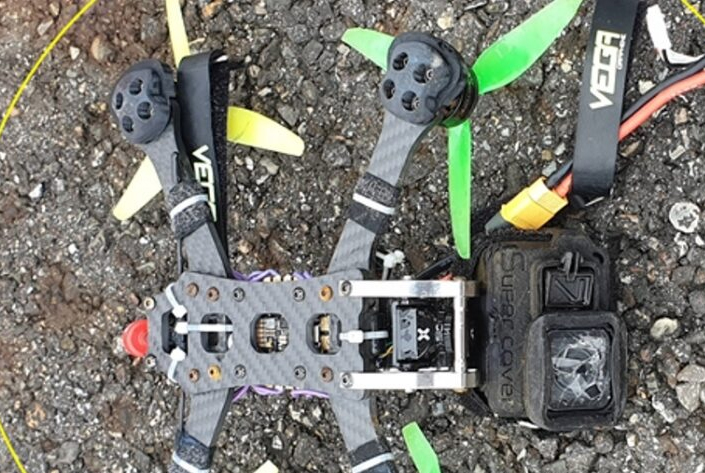
- Homemade Drone That Crashed at the Incheon LNG Terminal / Photo Courtesy of Rep. Eom Tae-young’s Office -
・ KOGAS to Introduce RF Scanners and Other Equipment
・ Plans to Neutralize Unauthorized Intruding Aerial Vehicles
・ Second Such System in the Region Following Incheon International Airport
Following Incheon International Airport, an anti-drone system will also be established at the Incheon LNG Terminal. As drone-based terrorist attacks have become a growing threat overseas, key national facilities in the Incheon area are strengthening their defense systems to respond to unauthorized aerial intrusions. Korea Gas Corporation’s (KOGAS) Incheon LNG Terminal Division announced on the 16th that it plans to establish an anti-drone system at the Incheon LNG Terminal by the end of this year. The anti-drone system will consist of an integrated control system, RF scanner, cameras, fixed jammers (radio-frequency interference transmitters), and drones for video surveillance. The Incheon LNG Terminal Division plans to use the system to prevent unauthorized drone intrusions. Specifically, the area within a 3 km radius of the LNG terminal will be designated as a drone flight-restricted zone. RF scanners will detect and identify drones, while jamming signals will be transmitted in an attempt to neutralize them. At the same time, the system will identify the location of drone operators and quickly relay the information to relevant authorities, including the police. An official from the Incheon LNG Terminal Division stated, “We plan to establish an anti-drone system to prevent unauthorized drone intrusions and drone-based terrorist threats.” Located in Yeonsu-gu, Incheon, the LNG terminal is a key national infrastructure facility that plays a central role in supplying natural gas to the Seoul metropolitan and central regions. However, the facility has previously faced concerns over its vulnerability to aerial threats due to the absence of a dedicated system for actively responding to unauthorized drone intrusions. In September 2019, drone attacks on two oil facilities in Saudi Arabia raised global awareness of the growing threat of drone-based terrorism. At the time, an attack involving 10 drones disrupted operations at facilities with a daily processing capacity of 7 million barrels, equivalent to approximately 70% of Saudi Arabia’s total oil production. Civilian drones, which are readily accessible and easy to operate, also pose a potential security threat to the LNG terminal. Last year, a drone operated by a civilian at a sports center near the terminal flew as far as the entrance to the LNG facility, raising serious security concerns. The terminal immediately reported the incident to the police, preventing the drone from approaching restricted facilities, but the incident highlighted the possibility of future unauthorized civilian drone intrusions. Incheon International Airport has also strengthened its drone defense capabilities. In September last year, it became the first civilian airport in Korea to establish a drone detection system, which detected more than 80 unauthorized drone flights by February of this year. In November of the same year, a drone detected near the summit of Osungsan Mountain, approximately 2.7 km from the airport, caused several aircraft scheduled to land at Incheon International Airport to divert to Gimpo International Airport and resulted in delays to arrivals and departures. Lee Byung-seok, a professor at the Korean National Police University, stated, “The possibility of drone-based terrorism should already be considered a threat within our daily lives. Government agencies, including the police, are developing counter-drone technologies and establishing relevant legal and regulatory frameworks to respond to drone-related crimes and terrorism, but these efforts need to be accelerated.”
Reporter Park Beom-jun (parkbj2@incheonilbo.com)
Source: Incheon Ilbo